Worldwide


October 23, 2026
Worldwide
There's an amazing piece of research from the Department for Education that every school leader, and every play designer, should sit with for a minute. It’s mainly looking at results in secondary education, but we believe that the learnings are every bit as relevant for primary aged pupils and a sense of belonging starts early. If you belong when you’re younger, then that will likely stay with you throughout your school years. You will continue to belong.
The research comes from linking the OECD's PISA 2022 survey to the National Pupil Database, tracking around 4,700 English 15-year-olds from their key stage 2 results through to their GCSEs. Buried in the questionnaire pupils filled in alongside their PISA test was one simple statement. ”I feel like I belong at school." Pupils had to rate how much they agreed.
The pupils who strongly disagreed scored, on average, nearly a full GCSE grade lower across their best eight subjects than the pupils who strongly agreed. That gap held even after the researchers controlled for prior attainment, free school meals eligibility, gender, ethnicity, special educational needs, and bullying. That feeling of ‘belonging’ was doing all of its own work, all on its own.
Only around six in ten pupils agreed they belonged at all - which is an incredibly sad statistic in its own right. Boys reported it more than girls. Pupils with SEN reported it least of any group. And interestingly, when the researchers swapped the single question for a longer, more complex index of belonging, the effect disappeared. It was the plain, ‘Do you feel like you belong’ statement, not the way the survey was put together, that tracked with results.
The report does NOT claim causation. Belonging and attainment were measured in the same window pupils sat their GCSEs, so we can't say belonging caused the grades rather than the other way round, or that some third thing caused both. But we don't think you need additional research to prove that a child who feels like they don't belong somewhere, will struggle to thrive there. We've just never seen it laid out this plainly, at this scale, by government researchers.
Belonging isn't taught in a lesson. It's built through repeated, small, physical experiences of being seen, included, and feeling like you’re part of a group. And the playground is where most of that building happens, for better or worse.
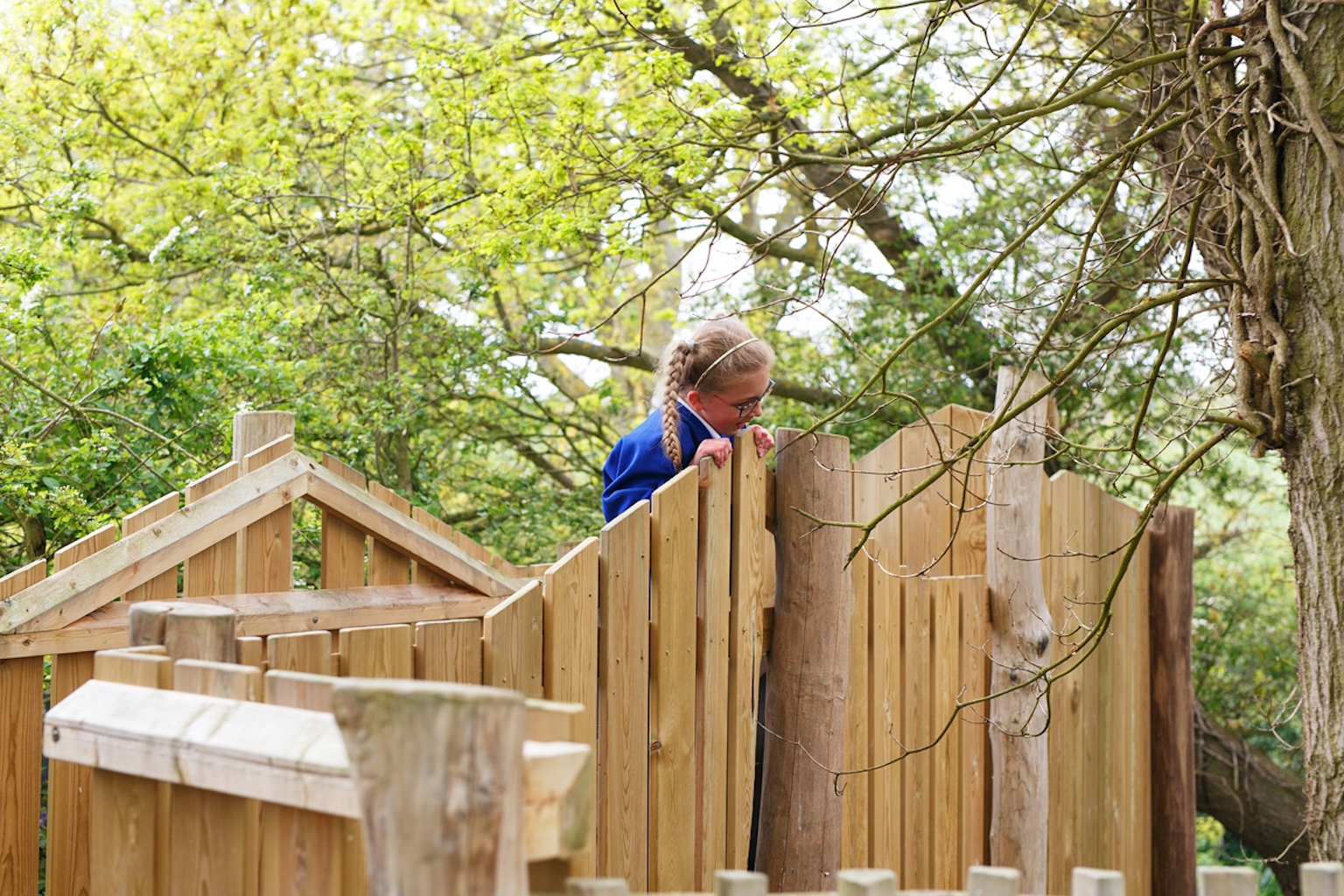
Think about what a good adventure play space in a school actually asks of a child. It asks them to take a manageable risk in front of their peers, and to be met with encouragement rather than mockery. It asks them to negotiate the question of whose turn it is on the rope swing or who's going first down the slide that only fits one at a time. It gives a child with no interest in football, or no ability to keep up with it, somewhere else to matter. None of that is incidental to play design. It's the actual mechanism by which a playground either welcomes a child into a school community or quietly tells them they're on the outside of it.
This is why we design the way we do. A few of the principles that run through every CAP.CO play space map almost exactly onto what the DfE data is describing.
Freedom and open-endedness. Unstructured play spaces let a child define their own role rather than compete for one predetermined by the equipment. A child who can't win at the swings can still be the architect of the den.
Manageable risk. Risk taken together, and conquered together, is one of the oldest social glues we have. A challenge that's genuinely shared, not merely observed, is what turns a group of children into a group of friends.
Story and sense of place. Play spaces built around a narrative, a WWII bunker, or a mighty galleon to sail into the sunset, give children a shared world to belong to, not just equipment. Ownership of a story is easier for a whole class than ownership of a climbing frame.
Accessible and inclusive design. A space only builds belonging for the children who can actually use it. Every child left standing at the edge of a play area is a child the research above would predict is drifting from the rest of their measured outcomes too.
We're not going to stand here and say a bespoke play space will close a GCSE attainment gap. The DfE report says that very clearly. But we can say that if belonging is worth almost a full grade across eight subjects, and if belonging is built in the small, repeated, physical moments of a school day, then the fifteen minutes at break and the hour at lunch stop looking like a gap in the timetable. They start looking like some of the most important equipment for delivering long terms results.
That's the case for treating play design as seriously as classroom design. Not as a nice-to-have once the academic work is done, but as one of the places where a school decides, every single day, who gets to feel like they're part of it.
Source: Department for Education, School belonging and attainment at key stage 4: linked data study (2026).